Open Alpha Retrospective — Two months of Open Alpha, what it taught us, and what we're building by the end of the year
Hello adventurers.
On July 10th, we pushed a feature-incomplete build of Lumenshard to production and opened the doors. We told you it would be rough. We told you balance would be strange, that systems would be missing, and that a wipe was coming. Privately, most of us expected the feedback to be some version of the same sentence: this isn't a game yet.
That is not what happened.
What happened instead was stranger and far more useful. The parts of Lumenshard we were most nervous about, combat feel, mob AI, the RPG systems we'd been building in isolation for three years, turned out to be the parts players liked most. And the part we had barely thought about, the first fifteen minutes of a new player's life, turned out to be a wall most people could not climb without someone holding their hand.
We had built a good room, or sandbox, to play in, but neglected the front door.
The numbers told us this before the players did, and we'll show you those numbers below, because they're the clearest thing in this entire post. What follows is the seven months of work that got us to July 10th, the two months of feedback since, the things that broke badly enough to be funny, the feedback we deliberately chose not to act on, and what all of it has turned into for the release we're targeting by the end of this year.
Hopefully you all enjoy some of the behind the scenes insight we'll share in this post.
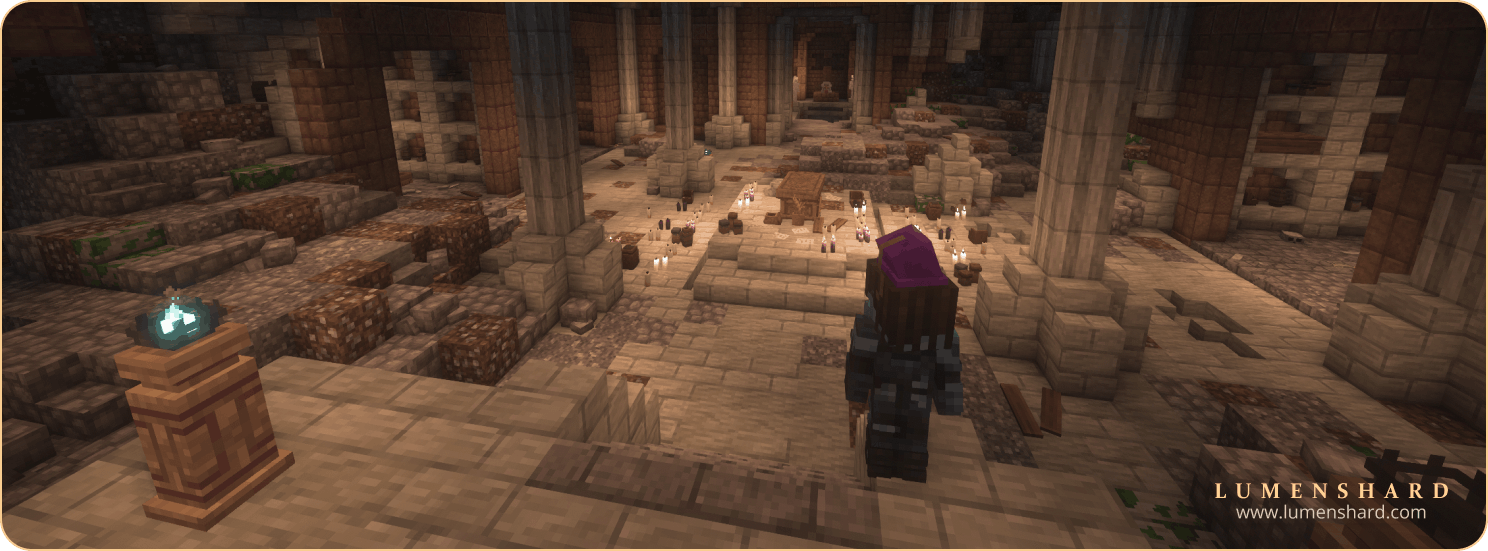
In the announcement post back in July, we said we'd been developing in a vacuum and were essentially guessing at what works. That was true. But it wasn't the whole reason we shipped.
The whole reason is this: after three years, the biggest risk to Lumenshard was never shipping rough. It was never shipping at all.
There's a specific failure mode that kills ambitious projects run by small teams, and we could feel ourselves sliding into it. Every month there was a defensible reason to wait. The crafting system wasn't fleshed out. Progression wasn't finished. There were only a handful of dungeons. Each of those was a real gap, and each was also a perfectly good excuse, and excuses compound. You can spend years building toward a launch that keeps moving because you keep finding new things that ought to be in it.
So the Open Alpha was, as much as anything, a forcing function aimed at ourselves. We picked a date, cut everything that wouldn't fit, and put it in front of people.
The result we care about most has nothing to do with any single feature, It's that we now ship to production roughly every two to three weeks. Before July, a change we made might sit in staging indefinitely (as we continued to add on to the scope creep), or waiting for some larger moment. Now there's a cadence, and the cadence is the thing that turns a passion project into a game. Everything else in this post exists because of that change.
Since we're going to keep using these words, it's worth saying what they mean to us, because they don't mean the same thing everywhere.
Beta, to us, means feature-complete. It does not mean finished, and it does not mean it's the game we're ultimately trying to build. It means every system that's going to exist has been in some way built and implemented.
Alpha is where we are, and where we intend to stay for a while. We'll remain in alpha until we're confident the full end-to-end gameplay loop has been designed from start to finish, not built, designed. Right now we're still learning as we develop. We test ideas, we watch what players do with them, and we change our minds. That's not a phase we're trying to rush through. It's the phase where a server, heck even full fledged games like this, either earns its design or doesn't.
So when you see us still calling this an alpha six months or a year from now, that's not a stall. It means we haven't yet reached the point where we'd bet the project on every decision we've made. When we do, we'll say so.
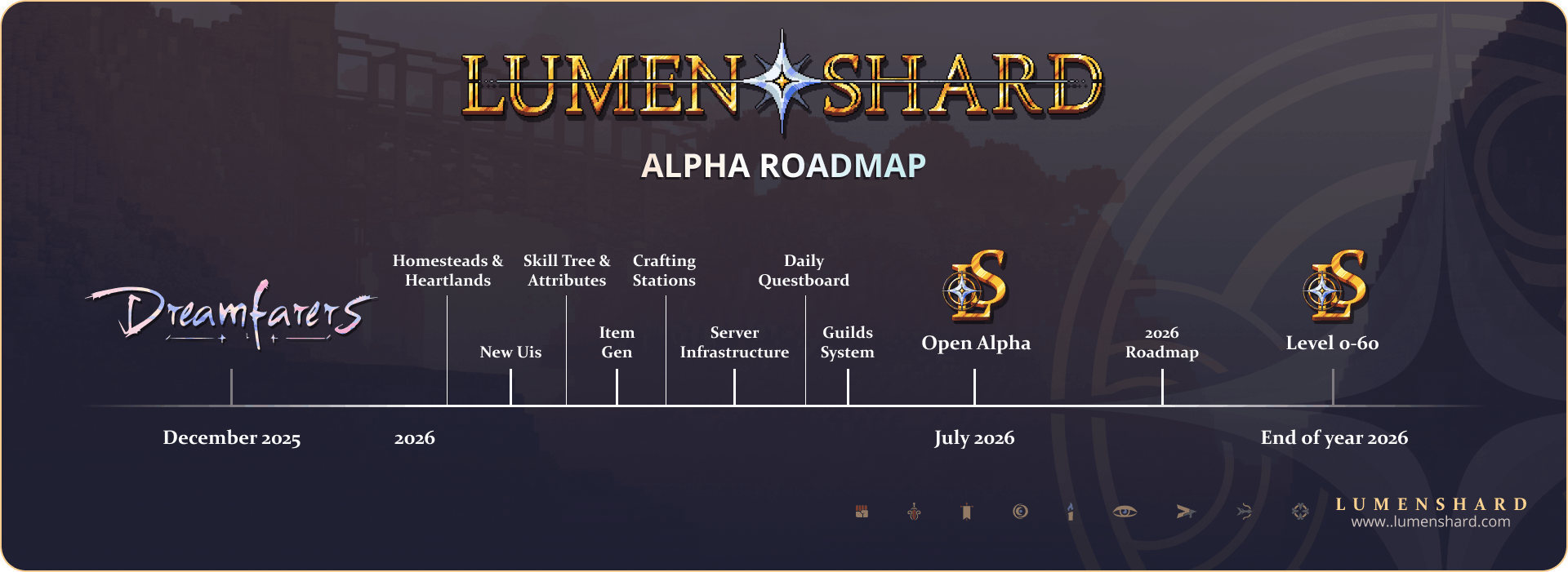
Work on the Open Alpha began in earnest right after the Dreamfarers release on December 14th, 2025. That gave us roughly seven months.
The challenge wasn't that we had too little, it was kind of the opposite, too many things that hadn't worked together yet: PvE combat, player progression, the RPG mechanics, tons of items, so many different interconnected mechanics, our first quest tooling, each had been developed as its own pillar, tested in its own controlled environment, and proven to work on its own terms. None had ever had to coexist in a single persistent overworld, with real players moving between them, with a new bestiary of mobs, with travel systems connecting spaces that had previously been just isolated worlds accessed through multiverse.
Seven months of work went into making those pillars into a world.
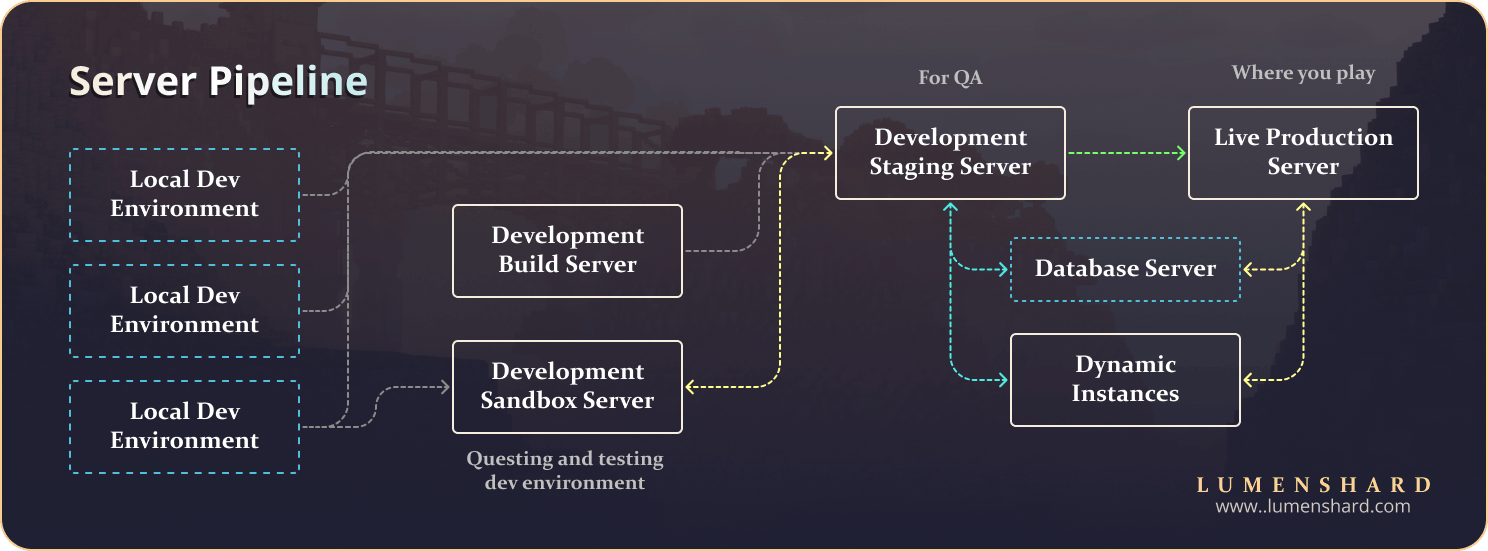
The single hardest technical problem we solved on the road to alpha had nothing to do with gameplay. It was our own tooling and server architecture.
Lumenshard doesn't run on a server. It runs on several, and they talk to each other. We built a development pipeline that lets us deploy updates in real time from our local machines through to a dev and QA staging server, where our team and a group of testers play content before it ever touches production. Only after it survives that does it go live.
The harder piece is what happens on production itself. The world instances — dungeons, troves, and the instanced content underneath Dreamfarers — aren't sitting there running all the time. They're spun up dynamically as players need them and spun back down when they're done. A party queues for a dungeon, and a dungeon comes into existence for them.
This is, genuinely, the thing we're proudest of technically, and it's also still early and still occasionally unstable. We'll get to exactly how unstable further down.
What we want to say here is this: every release we push to production carries a stack of infrastructure work you will never see in a patch note. You don't notice a dungeon spinning up correctly. You only notice when it doesn't. A large share of our effort goes into that invisible layer, and it's the reason the experience gets smoother every single release even when the visible changelog looks modest.
To hit July 10th, we cut aggressively. Two cuts mattered more than the rest.
Crafting stayed at tier zero. We launched with 5 of 18 planned assembly stations and workstations, and roughly 200 of 800+ planned items and resources obtainable. That's not a rounding error, that's most of a system left in the box.
Progression was capped at 30 instead of 60, and compressed to fit. Our actual long-term design is a 0–60 journey. What we shipped was that journey squeezed into half the space.
Both cuts were deliberate, and the reasoning was the same for each. Our goal for the Open Alpha was never to test whether Lumenshard was balanced or fun in a final sense. It was to test whether the discrete systems that power the game actually worked when connected to each other, under real players, at the same time. Balance, economy, and crafting could all be out of whack, as long as the machinery underneath held together.
That was the right call. It also had a cost we underestimated.
Compressing 60 levels of progression into 30 made things both faster, but also incoherent. Content that should have posed a real threat quickly became quite easy to deal with and farm. The gap between content was huge, where the nex big challenge, being the first and onyl dungeon was a wall that either flattened players or they would breeze through. We know, the difficulty curve wasn't a curve, it was a set of stairs with most of them missing.
We knew balance would be rough. We didn't fully appreciate that compressed progression doesn't produce rough balance, it produces nonsensical balance, and that the difference matters a great deal when you're asking players to tell you how something feels (which was reflected in the public feedback channels we have on Discord, thank you to those who contributed, it helped power the conversation).
Worth stating plainly, because it shapes everything above: Lumenshard's core team is four people working on this full time (part-time really, we all have jobs and lives as well), end to end. Between us we cover engineering, systems design, world building, art, UI, and VFX. We pay contractors for sound and music, and occasionally for pixel art support, and we're helped by a rotating group of builders, artists, and creatives who contribute as they're able.
That's the whole operation.
We did zero marketing for the Open Alpha. No campaign, no paid promotion. Word of mouth, our Discord, and whatever curiosity a decade-plus of A'therys history still carries.
Here's what that produced:
While 28 concurrent is small for a Minecraft server. If you're comparing us to an established network, it's a rounding error. I'm not going to dress it up, but it's also the wrong comparison, for an unannounced, unmarketed, openly feature-incomplete alpha where we shared a ton of warnings, ~60 people showing up was a huge boost to the teams morale and motivation.
The third number is where it gets interesting, because that average hides the single most important thing we learned. Break the same population into groups:
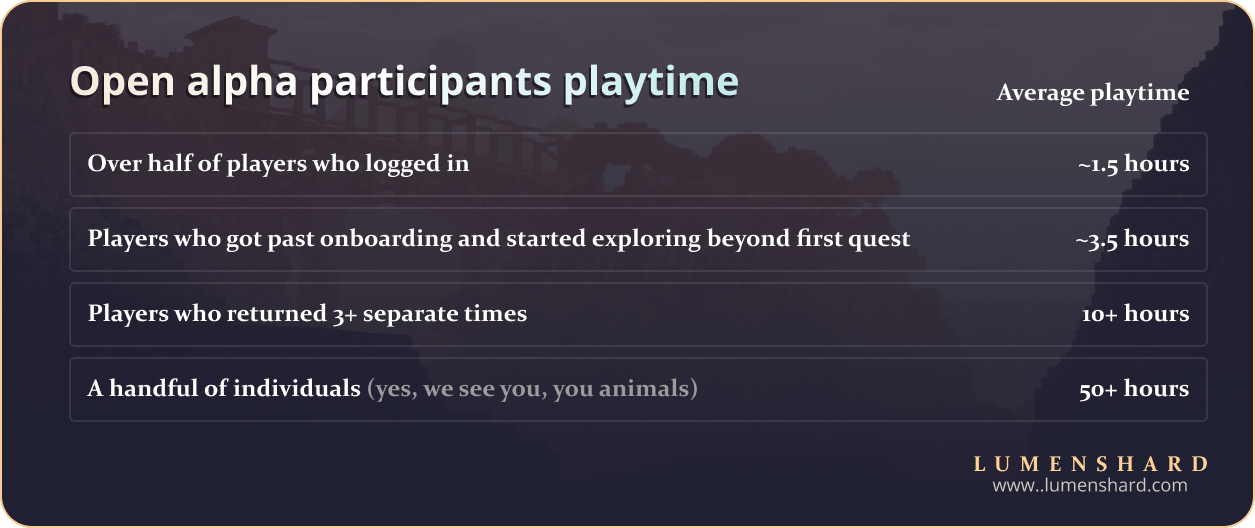
That distribution tells us something we couldn't have learned any other way. Lumenshard isn't failing to hold people. Once it has them, it holds them extraordinarily well for those able to work around the extremely rough edges, better than we had any right to expect from a build this incomplete.
We knew onboarding was unfinished. What we didn't appreciate was that onboarding wasn't a missing feature sitting alongside the others. It was a gate in front of all of them. Every hour of work we'd put into skills, attributes, combat, dungeons, and progression sat behind a door most people couldn't find the handle on. You can build the best encounter design in Minecraft and it's worth exactly nothing to a player who logged out at minute twelve because nobody told them to walk through a fountain.
The other half, everyone who got through that door stayed.
Players who made it past those first 15-30 minutes started experimenting: skill trees, attribute point spreads, gear, wild build combinations we hadn't anticipated. They found the single dungeon we'd shipped and ran it repeatedly. They kept discovering things. One of the most consistent patterns we saw was players stumbling onto some system they hadn't known existed, hours into a session. Three years of accumulated depth turned out to reveal itself slowly, which is a much better problem than the alternative.
And then they did something we absolutely did not expect. They came and found us.
Players joined voice calls with the developers, unprompted, to talk about design. Not to report bugs (though they did plenty of that) but to argue about systems, propose ideas, and dig into where we were taking the project. Several volunteered for QA almost immediately and are still with us.
We went into July 10th braced for indifference. We came out of it with a community that want to see this thing come to life, and to help build it.
By a wide margin, the loudest feedback we received was about instanced content — troves and dungeons — and specifically about the act of getting into them.
The failure modes stacked up fast:
That last one was as funny as it was infuriating, and it deserves to be recorded properly, because it's the purest illustration of what this alpha was for. We had built a system that could conjure a dungeon out of nothing on demand. It worked beautifully on our end, and in QA, and in staging. It took about thirty real players to discover that under actual concurrent load it would occasionally conjure the nothing instead.
And we did not find this in a meeting, we discovered it and put a plan together only because we had shipped something, which was the point all along.
What we did about it: we rebuilt the entire backend responsible for routing players into game content. In its place is a proper matchmaking and queue system, which lands in an upcoming update and fundamentally changes how you enter instanced content.
This is the section we expect to be most debated, so we want to be direct about it.
A lot of the feedback we got was about balance around specific encounters that were too punishing, progression pacing that lurched, etc. and all of it was accurate, but, we did not act on most of it, as that had't been the point of the alpha just yet (fixing it would have meant carefully tuning a system we already knew we were about to delete). Balancing that 0-30 level progression and compressed system would have produced a nicely tuned version of something temporary, and taught us almost nothing about the system we actually intend to ship. So instead of tuning it, we tore it out.
Here's what "tore it out" actually meant over the last two months:
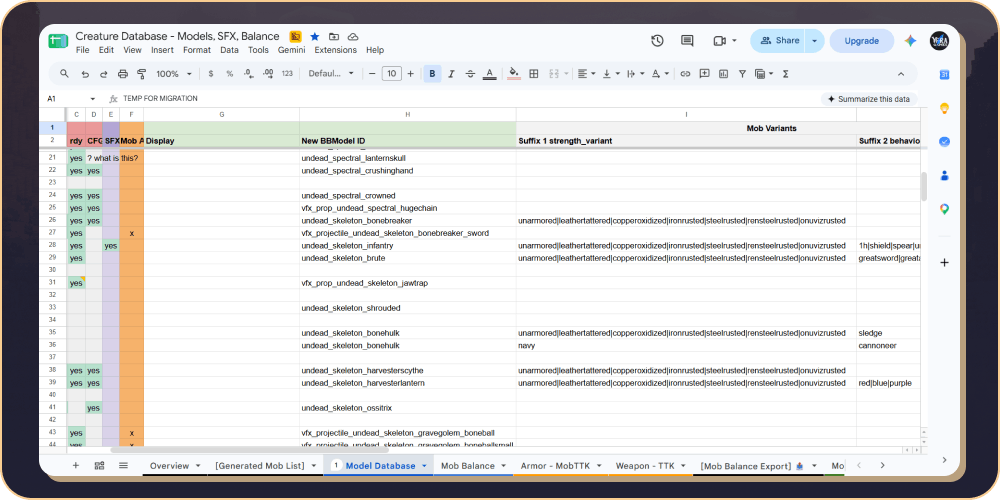
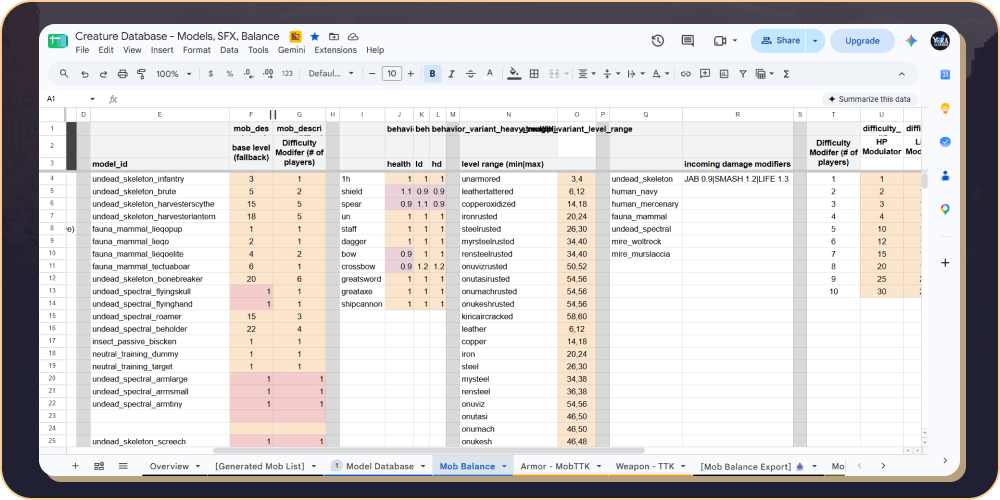
Previously, adding a mob meant hand-tuning it against a moving target and hoping. Now mob stats, damage, health, and rewards derive from formulas driven by level, faction groups, and a few other levers. Adding the next hundred mobs from our backlog is a matter of defining what a mob is and letting the system place it, rather than weeks of manual balancing per creature.
The practical result: the version of Lumenshard currently on production is already meaningfully closer to our intended final balance for the early regions than the Open Alpha ever was. Not final. Closer, and for the first time built on something that can get there.
So when we say we didn't act on your balance feedback, what we mean is that we took it as evidence the foundation was wrong, and replaced the foundation. Sometimes the right response to "this is unbalanced" is "yes, and we're deleting the thing that made it that way."
Everything above points at one release, targeted for the end of this year, around the holiday season. We're not putting a date on it. We've learned what dates do to a four-person team.
Here's what's in it.
We're starting here, because the funnel says we should.
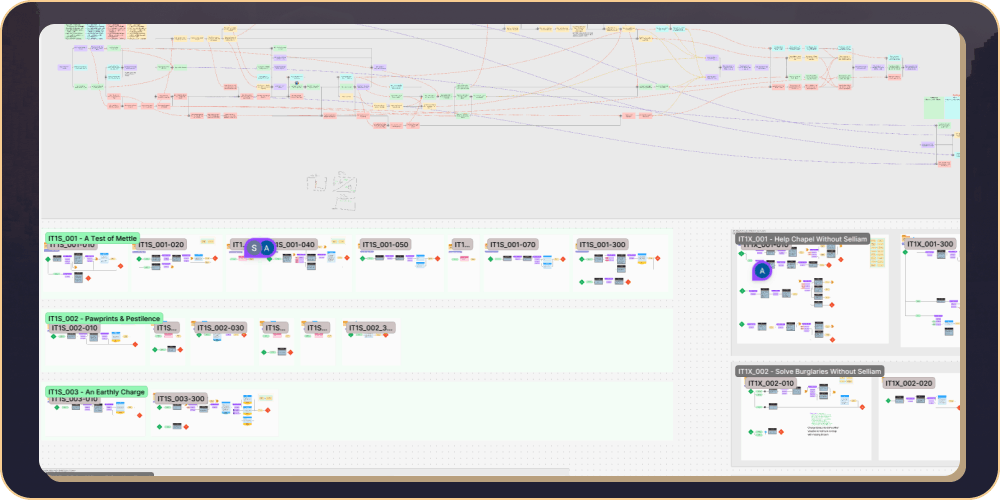
By the end of the year, Lumenshard will have a comprehensive in-game onboarding experience. Not signage. Not a wiki page. A guided flow that takes you by the hand from your very first login and walks you directly into the game through our quest system.
The same quest system that drives content throughout the rest of the game is the system that introduces you to it. You aren't being trained and then released into Lumenshard; you're in Lumenshard from the first step, doing the thing you'll be doing for the next sixty levels.
Supporting that, we're introducing a quest journal, conspicuously missing from the Open Alpha, and one reason even players who did pick up quests frequently lost the thread of what they were meant to be doing. The journal tracks both your onboarding steps and every quest after them, so there's always an answer to "what now?" a few keypresses away. It lives, of course, inside the inventory UI. We remain fiercely committed to a command-free experience.
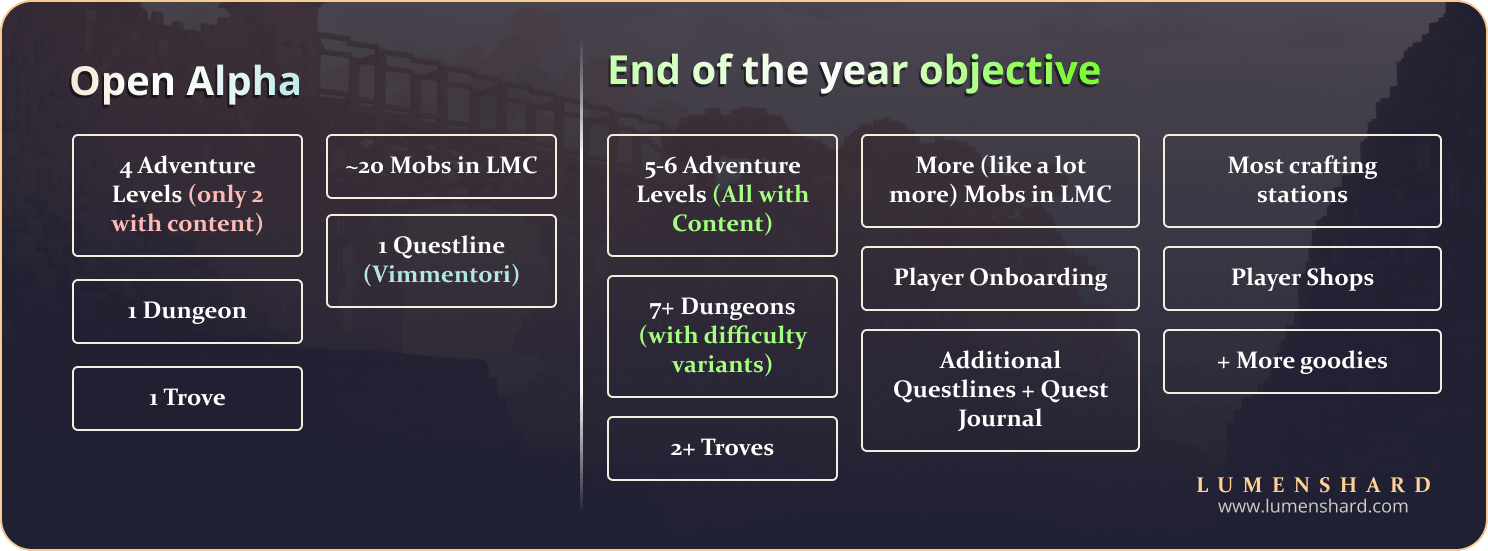
At launch we had 4 Adventure Levels (only 3 with spawn regions active), 1 dungeon, 1 trove, and 1 boss.
By end of year we're targeting 6 Adventure Levels, 7+ dungeons, 2+ troves, and many more bosses.
Two of those Adventure Levels are new, and they do very different jobs:
Zastria's Crossing extends the journey to roughly level 30-35. Our current four take players to about 25. This is the first real step out of the compressed alpha progression and toward the true 0–60 design.
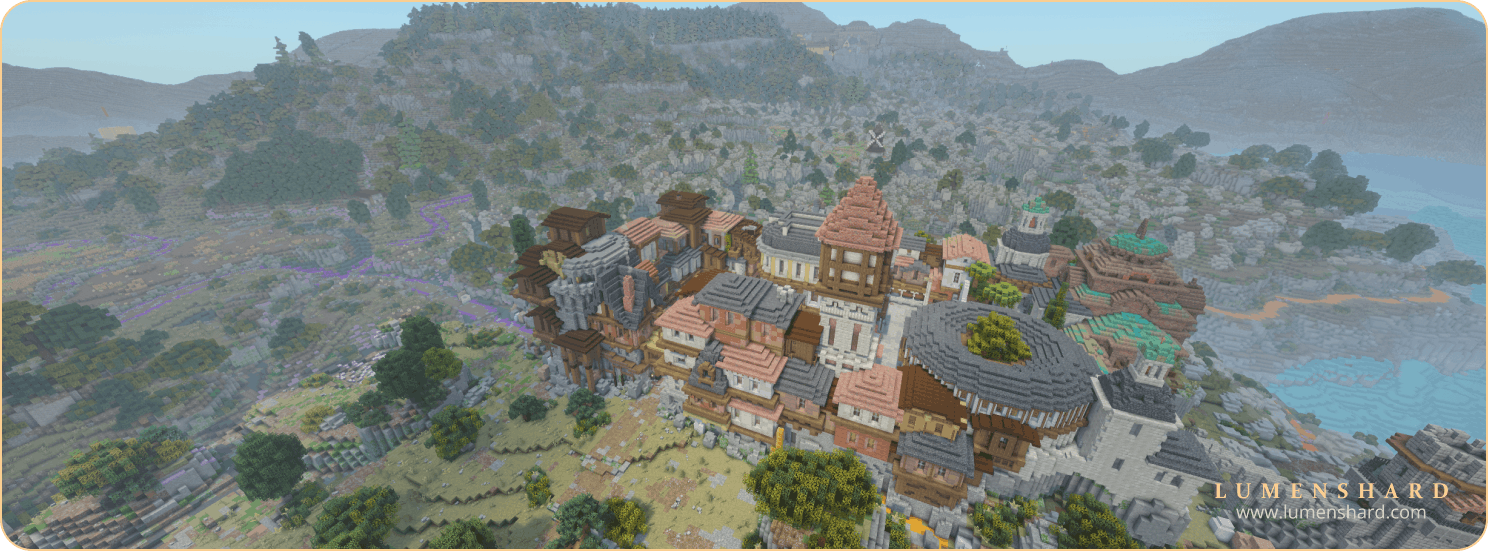
A sixth Adventure Level built for level 60+. This one is a statement of intent. It's endgame territory — content for players who've finished the climb, with its own level 60+ dungeon, and it's designed as the gateway to higher-level content beyond it. We're building the top of the mountain at the same time as the path up it, because an MMORPG whose endgame is an afterthought is an MMORPG people leave.
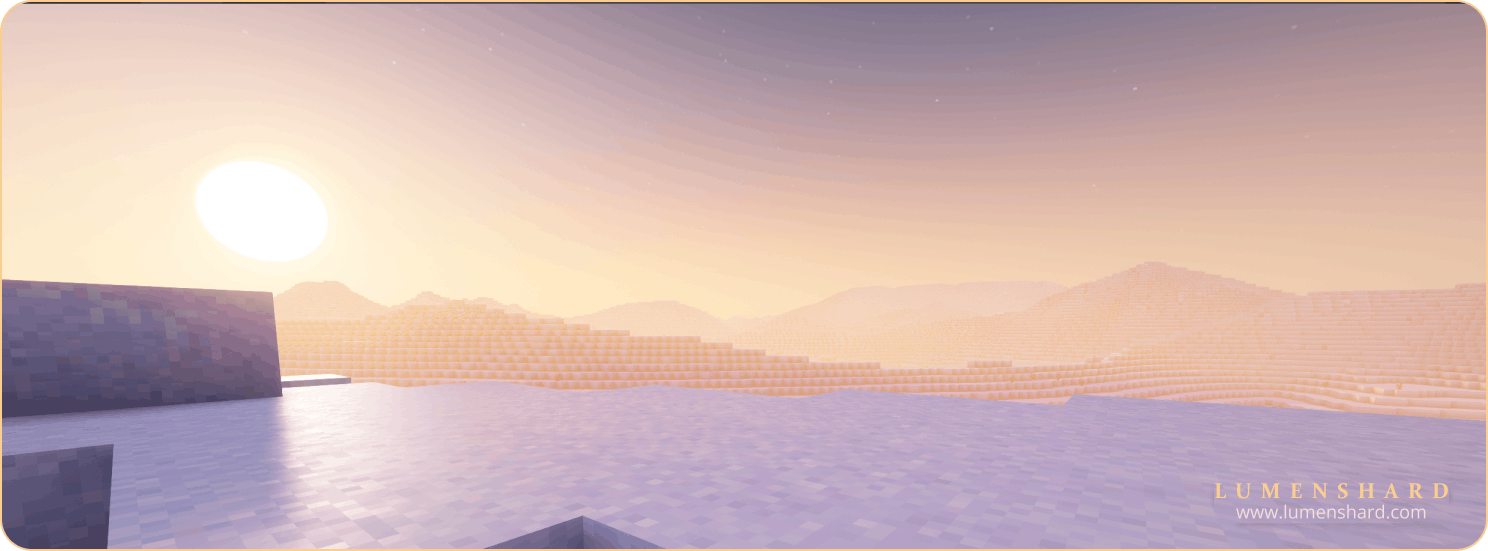
With the new queue and matchmaking system in place, every dungeon is getting three difficulty tiers, each spanning roughly 10–20 levels. Combined with the expanded Adventure Levels, the goal is that there's dungeon content available to you roughly every five levels from early game onward. No more single dungeon carrying the entire experience.
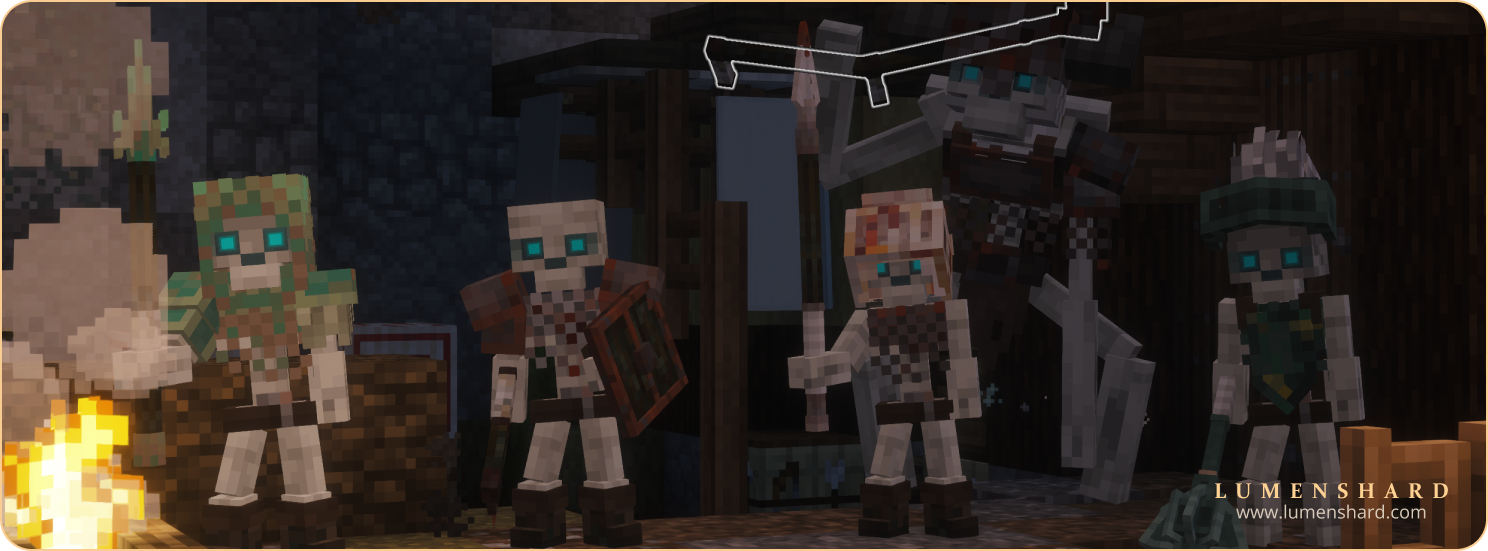
This is a design stance we want to state clearly, because it's central to how Lumenshard works and it's the opposite of what most games do.
We do not scale mobs or levels to the player. Nothing currently in Lumenshard quietly adjusts itself based on who walked in.
Higher difficulty tiers contain genuinely different mobs. If you fight a copper-armored skeleton in a dungeon's base difficulty, that same dungeon at a higher tier doesn't give you the same skeleton with inflated numbers. It gives you a steel-armored skeleton: a different creature, with different equipment, different stats, and at times different behaviour. That principle applies across every mob in every dungeon we're bringing into the experience.
The reason is simple. Level scaling makes progression feel like running on a treadmill: you get stronger, the world gets stronger with you, and nothing ever actually changes. We'd rather you walk into a place too dangerous for you, get turned around, come back three levels later, and win.
The cost is enormous content volume. That's why the modular rebalancing work above mattered so much, and why the bestiary had to more than double before we could commit to this.
Guilds remain central. Guilds will continue to own land within the Heartlands, and building there stays tied to guild-owned territory — as it was during the alpha — because we want the map to be shaped by groups of people rather than scattered individual claims.
What's changed is where PvP sits in the journey. With progression rebuilt toward the full 0–60, we expect meaningful player-versus-player conflict to begin between levels 55 and 60.
In the July announcement, we listed the lack of crash recovery as a known limitation and called it one of our biggest roadmap focuses. Closing that loop:
During the alpha, if you disconnected (server-side or client-side) you lost whatever you were doing. Log back in and you were in the hub, and anything happening inside an instance was simply gone. It was one of the most demoralizing things a player could experience, and it happened often.
That's now rebuilt. The server remembers your last position and does its best to return you there when you log back in, including inside instanced content. And if your whole party crashes together, the instance is held for up to five minutes so you can all get back in and continue the run you were on.
Dying now has real structure to it, wherever it happens, Heartlands, Adventure Levels, dungeons, or troves. Your options:
With options 2 and 3 being a selection, you as a player, will be able to make.
To everyone who logged in since July 10th: thank you. To the handful of you who put a hundred-plus hours into a build we openly told you would be wiped (we don't entirely understand you, and we're enormously grateful for you). To those who joined voice calls to argue about design, and to the players who walked straight from "this is broken" into volunteering for QA: you're the reason this post has anything worth reporting in it.
Progress will continue to be wiped periodically while we experiment, and that will remain true for as long as we're in alpha.
If you want to follow the work itself rather than wait for posts like this one: our project board streams live into our Discord in the #pm-updates channel. Every bug fix and every major feature card posts publicly as it moves. You can watch the sausage get made!
Anyway, expect a major update atleast once a month, and periodic small updates on Fridays (inconsistent).
-
Additionally, thank you to those who continue to reac tin Discord, push us to provide more updates and support us on Patreon, your support means the world and keeps us going even after 3+ years of development at this time. We're really close now and as you can see above, the pace is shifting gears now that we're finally in a place to get content in to the game in a more final state.
Biggest names that I want to just give a shoutout, and immortalize in this blog post at this time, in alphabetical order: